| |
 |
|
Saudi Arabian
Airlines has developed into one of the world’s
leading carriers, with a fleet of 91 aircraft
transporting 16 million passengers a year to
more than 70 domestic and international destinations
|
Flying high
in the newly opened skies
A new epoch
of privatisation, open competition and low-cost challengers
heralds exciting times for the national flag carrier
Commercial air travel in Saudi
Arabia has come a long way since American president
Franklin D. Roosevelt helped establish the nation’s
first airline when he gave King Abdul Aziz a twin-engined
DC-3 Dakota back in 1945. In the 60 years that have
followed, Saudi Arabian Airlines has developed into
one of the world’s biggest carriers, its fleet
of 91 aircraft speeding some 16 million passengers
a year to more than 70 domestic and international
destinations across the globe.
Now in the early 21st century,
air travel in the Middle Eastern kingdom is entering
into a new era which will involve the privatisation
of Saudi Arabian Airlines, the ending of its 60-year
monopoly on scheduled domestic flights and the establishment
of a new range of low-cost services.
Saudi Arabian Airlines is
in good health as it faces up to these new challenges
with profitability more than doubling between 2003
and 2005 to reach a figure of some $133 million (£66.7
million). Passenger numbers, which increased by nearly
half a million in 2006, are expected to rise by up
to 15 per cent a year, with the number of Muslim pilgrims
visiting the kingdom rising to 20 million over the
course of the next decade.
“We have improved and
simplified services for our customers, the economy
is booming and traffic has increased,” says vice-president
for customer services Yousef Attiah. “The airline
serves so many different segments of customers: pilgrims
travelling for the Hajj and Umrah religious festivals,
businessmen and domestic travellers. So growth is
good, but one of our major challenges is to find the
best way to meet demand.”
 |
 |
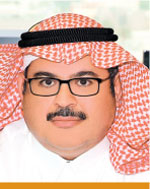
| KHALID ALMOLHEM Director
General Saudi Arabian Airlines |
YOUSEF ATTIAH
VP of Customer Services of Saudi Arabian Airlines |
An improvement in customer
service is one of the key elements of the airline’s
long-term development strategy as outlined by director
general Khalid Almolhem, the man who oversaw the successful
privatisation of Saudi Telecom in 2003.
Saudia, as the airline is
often known, has started using state-of-the-art reservation
and ticketing systems with the first e-ticket being
issued by the director general earlier this year.
Internet bookings, self-service boarding passes and
a high-tech voice response system to check reservation
status are also now being introduced.
Information on ticket prices,
air routes and reservations is being provided through
SMS text messages on mobile phones, while lounges
for first class and executive travellers have been
extended and modernised.
“We have introduced e-ticketing
for domestic flights and we have improved on-board
services in term of food and entertainment and sky
sales,” explains Mr Attiah. “We have almost
one million SMSs sent monthly to our customers to
remind our passengers of ticket time limits, to confirm
reservations, and provide information about departure
times. The passengers are very happy with the new
service.”
The improvement in customer
service is a prelude to the airline’s privatisation
programme which has begun with the sale of a 49 per
cent stake in its catering unit for a figure of at
least $373.3 million (£187 million).
| |
 |
|
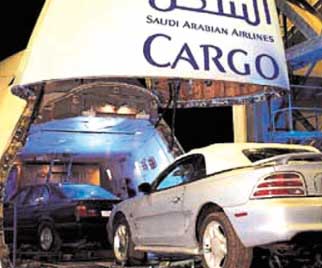
A ten-year
plan for privatisation will begin this year
with catering services and cargo, with other
units to follow shortly afterwards
|
Launched in 1981, the catering
business produced some 15 million meals in the first
nine months of 2005 alone.
It generated a turnover of
$171.5 million (£86 million) in 2005, a net
profit of $38 million (£19 million) and a net
operating margin of 25 per cent making it a highly
attractive target for investment.
The catering division is the
first of five units the airline plans to privatise
before moving on to sell a stake in its core passenger
transport service. Cargo, ground handling, maintenance
and the flight academy will all follow before the
core of the airline itself.
“The strategy so far is to approach strategic
partners,” explains Mr Attiah. “Up to 49
per cent of the catering section should be in the
hands of a strategic partner, then Saudia shares will
go for public offering at a later stage.”
The airline is confident the
formation of independent companies for each unit will
boost growth, enforce a customer-oriented mentality
and help meet rising competition as the kingdom liberalises
air transport in the 21st century.
new routes
More European
connections
In addition to the government’s
efforts to highlight the nation’s tourism potential
internationally and the ever-increasing numbers of
pilgrims coming to the country, Saudis love to travel,
spending around SR60 billion (£8.1 billion)
annually on domestic and international travel and
tourism.
Saudia director general Khalid
Almolhem is enthusiastic about the prospects in the
sector. And far from fearing the arrival of NAS and
Sama on the scene, Saudia believe that the increased
competition is vital if passenger demands are to be
met.
The national carrier offers a regular schedule between
Saudi Arabia and a number of major European cities.
Regarding the UK, the airline
has a total of 12 flights to London Heathrow –
five operating from Riyadh and seven from Jeddah.
Furthermore, effective from 22nd June, Saudi Arabian
Airlines has launched twice weekly flights connecting
the kingdom with Athens, Manchester, Munich and Vienna.
low-cost
Burgeoning
budget carriers
Perhaps the clearest indication
of the revolution in air travel in the Middle East
is the emergence of low-cost carriers and Saudi Arabia
is keen to embrace the new trend in order to meet
increasing demand.
Saudi Arabian Airlines are
studying the potential of developing a new low-cost
arm to add to their well-established operations, while
the kingdom’s civil aviation authority has given
the green light for private airlines Sama and NAS
to take advantage of the burgeoning budget carrier
market.
Saudi Arabia is a promising
market for low-cost airlines given that some 75 per
cent of the country’s expatriate workers earn
low salaries of around £267 per month and are
likely to favour the new carriers to travel to their
home countries.
Low-budget airlines are a
relatively new phenomenon in Saudi Arabia. Their arrival
is significant at a time when the industry is faced
with economic challenges from rising costs and increased
competition as more and more countries are adopting
an open-sky policy.