| |
 |
|
In focus:
biotechnology is an investment priority for
both federal and state governments
|
A new ‘gold
rush’ Down Under
Biotechnology
is one of Australia’s fastest growing industries and
winning the country an international reputation for
research and development
Biotechnology is “the
21st century equivalent of the gold rush” and
Australia’s modern day prospectors are “the
scientists searching our rainforests and the reef
for cures to diseases and afflictions.”
It’s easy to see what
Peter Beattie, the premier of Queensland State, means
– biotech is booming Down Under. Australia is
the fifth largest centre for biotechnology after the
US, Canada, Germany and the UK. It has established
a global reputation for research and development (R&D)
and its capabilities in human therapeutics, agribiotech,
diagnostics, medical devices and biodiscovery.
With biotechnology and life
sciences predicted to overtake information and communications
technology as the world's largest industry by 2030,
both the federal and state governments have identified
scientific innovation as the engine of future economic
growth and made it a priority area for investment.
The number of core biotechnology
firms in Australia has mushroomed from less than 200
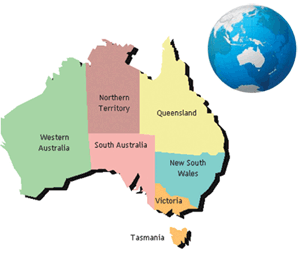
in 2001 to well over 400; most are based in Victoria,
New South Wales and Queensland. Almost 100 firms are
listed on the Australian Stock Exchange (ASX) and
their total revenue exceeds A$3 billion (£1.2
billion).
Industry experts predict that
2006 will prove to have been Australia’s second
biggest year for biotech investment, which is expected
to total around US$26 billion (£10.4 billion).
Biomedicine is the dominant
point of focus. Forty-seven per cent of Australia’s
biotech companies deal with human therapeutics, 16
per cent with agricultural biotechnology and 14 per
cent are diagnostics firms. There are also more than
600 medical devices companies.
Australia is at the forefront
of health and medical research, accounting for 3 per
cent of world activity in this field. Landmark breakthroughs
have been chalked up in stem cell research, anti-viral
vaccines and cancer treatment.
The country has always had
strong research entities like the Commonwealth Science
and Industrial Research Organisation (CSIRO) and the
Walter and Eliza Hall Institute of Medical Research.
Today, it boasts a critical mass of international
biotechnology organisations that, according to Ernst
& Young, generate 67 per cent of total public
biotechnology revenues for the Asia Pacific region.
Collaboration is the watchword
both at home and internationally. In 2005, Australian
biotech companies announced 339 partnerships, 72 per
cent of which were with organisations overseas. The
federal government and all six Australian states have
linked up with the government of New Zealand in the
Australia-New Zealand Biotech Alliance.
“From a trade promotion
point of view, we try to get both the government and
industry acting together,” says Peter O’Byrne,
managing director of Austrade. “If we present
the excellence in Australia in total, we have more
impact.”
Significant progress has been
made in commercialising research discoveries. Dr Peter
Riddles, one of Australia’s most experienced
biotechnology experts, says: “The biggest shift
in the last ten years has been that we have become
much better at starting new ventures, much better
at raising money and capital to drive the commercialisation
process and product development through the necessary
trials.”
Dr Anna Lavelle, CEO of the
national biotech industry body AusBiotech, points
out the potential for investors to participate in
biopartnering and collaborative arrangements to develop
technologies. She says: “We offer an exceptional
range of opportunities for firms wanting to invest,
partner and/or license our biotech IP (intellectual
property).”